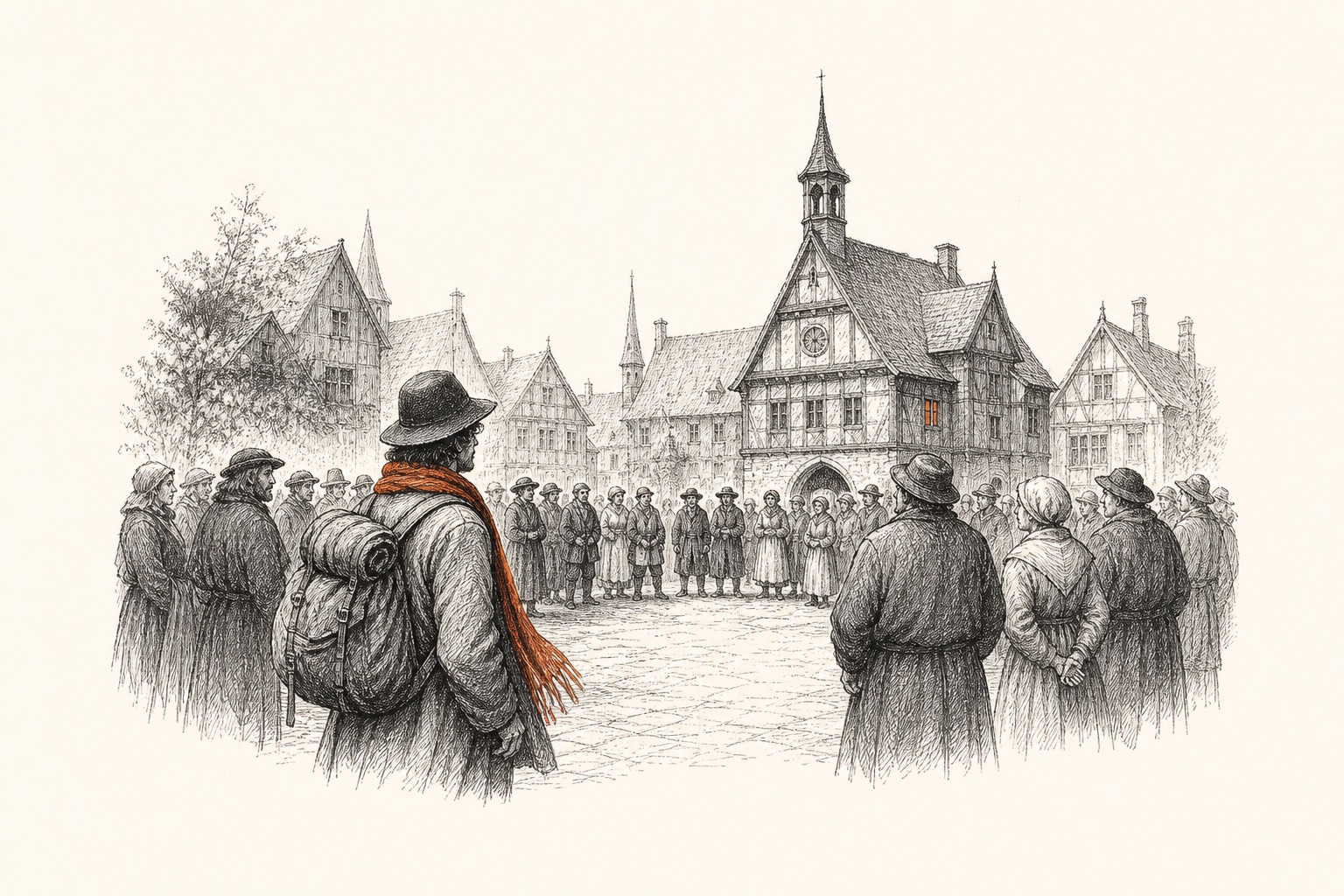
If wandering, considered as the liberation from every given point in space, is the conceptual opposite to fixation at such a point, then surely the sociological form of “the stranger” presents the union of both of these specifications. It discloses, indeed, the fact that relations to space are only, on the one hand, the condition, and, on the other hand, the symbol, of relations to men. The stranger is not taken here, therefore, in the sense frequently employed, of the wanderer who comes today and goes tomorrow, but rather of the man who comes today and stays tomorrow — the potential wanderer, so to speak, who, although he has gone no further, has not quite got over the freedom of coming and going. He is fixed within a certain spatial circle — or within a group whose boundary is analogous to a spatial one — but his position within it is peculiarly determined by the fact that he does not belong in it from the first, that he brings qualities into it that are not, and cannot be, native to it.
The union of nearness and remoteness, which every relation between men comprehends, has here produced a constellation which may, in the fewest words, be thus formulated: the distance within the relation signifies that the Near is far; the very fact of being alien, however, that the Far is near. For the state of being a stranger is naturally a quite positive relation, a particular form of interaction. The inhabitants of Sirius are not exactly strangers to us — at least not in the sociological sense of the word as we are considering it; they do not exist for us at all; they stand beyond far and near. The stranger is an element of the group itself, not otherwise than the poor and the various “inner enemies” — an element whose inherent membership involves both an exterior and an opposite. The manner in which mutually repulsive and distancing elements here compose a form of joint and interacting unity may now be briefly indicated — by no means as an exhaustive account.
the Near is far
the Far is near

In the whole history of economics the stranger makes his appearance everywhere as a trader, and the trader as a stranger. As long as production for one’s own needs is the general rule, or products are exchanged within a relatively narrow circle, there is no need of any middleman within the group. A trader is only required for those products which are produced entirely outside the group. Unless there are people who wander out into foreign lands to buy these necessities — in which case they are themselves “strange” merchants in that other region — the trader must be a stranger; no other has a chance of existence.
This position of the stranger is intensified in our consciousness if, instead of leaving the place of his activity, he fixes himself in it. For in countless cases this too is possible for him only if he can live by trade as a middleman. Any closed economic circle in which the land and the crafts that satisfy local demand have already been divided will still grant an existence to the trader. For trade alone makes possible unlimited combinations; in it intelligence finds ever wider extensions and ever newer openings, a thing rarely possible for the primary producer with his lesser mobility and his restriction to a circle of customers that can only very gradually be increased. Trade can always absorb more men than primary production, and it is therefore the most favorable province for the stranger, who thrusts himself, so to speak, as a supernumerary into a group in which all the economic positions are already occupied. History offers as the classic illustration the European Jew. The stranger is by his very nature no landowner — land being taken not merely in a physical sense but also in a metaphorical one, as a permanent life-substance fixed, if not in space, then at least in an ideal position within the social circle (gesellschaftlichen Umkreises). Even in the more intimate relations of person to person the stranger may disclose all possible attractions and significant characters; yet, so long as he is felt as a stranger, he remains in all else “no landowner”.
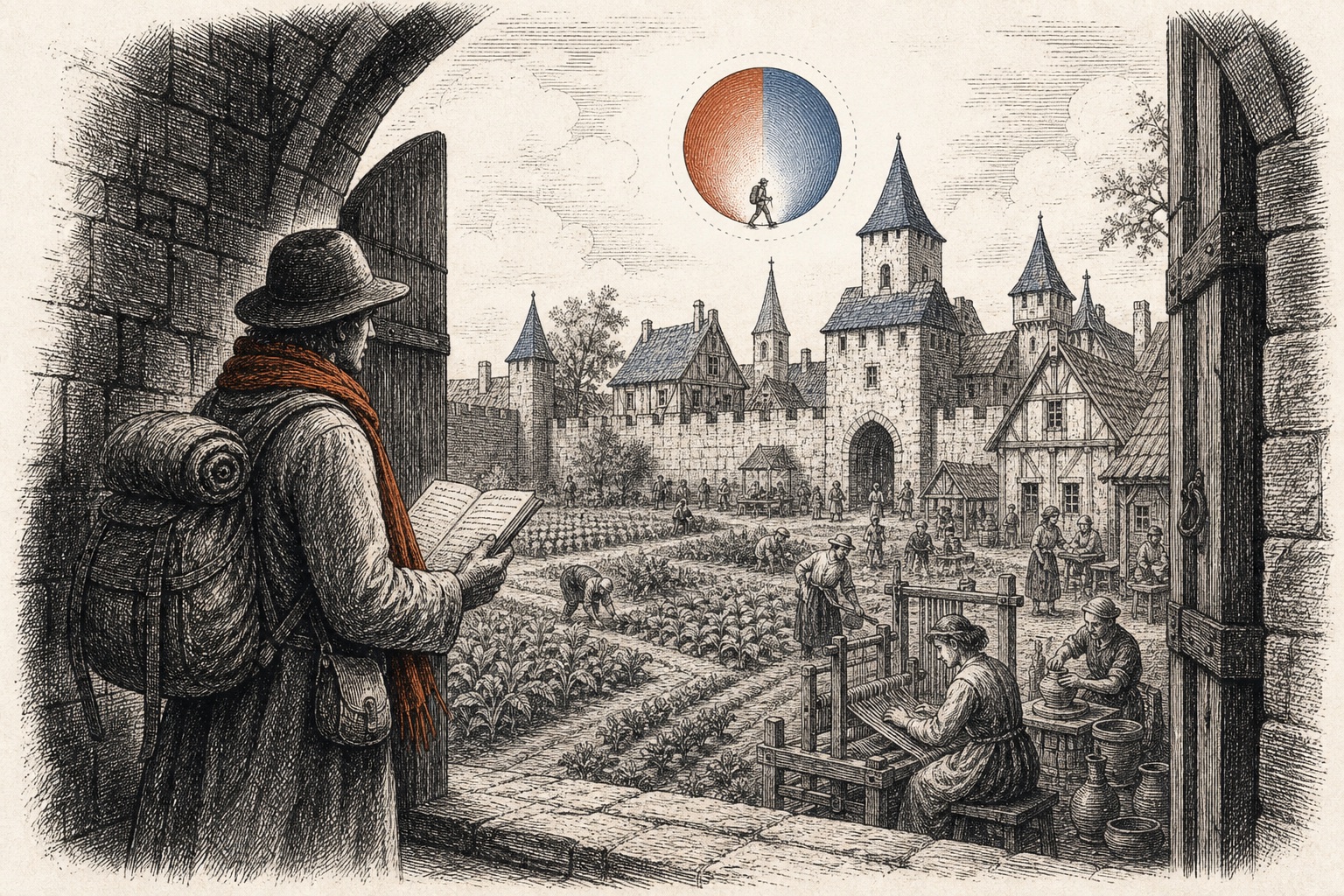
Now this necessity of the middleman’s trade, and, still more, as if by a sublimation from it, the necessity of purely monetary business, gives the stranger the specific character of mobility. In this mobility, when it occurs within a limited group, there occurs that synthesis of nearness and remoteness which constitutes the formal position of the stranger: for he who is wholly mobile comes incidentally into contact with every single element, but organically, through the established ties of kinship, locality, or profession, is bound up with none of them.
Another expression of the same constellation lies in the objectivity of the stranger. Because he is not rooted in the peculiar constituents or one-sided tendencies of the group, he stands over against them all with the peculiar attitude of the “objective,” which does not indicate simply distance and disinterestedness but is a peculiar composition of remoteness and nearness, indifference and engagement. I refer the reader to the discussion (in the chapter “Superordination and Subordination”) of the dominating positions of the stranger in the group, of which the typical instance is the practice of those Italian cities that called their judges from without, because no native was free from the prejudices of family interests and factions. Connected with the objectivity of the stranger is also that phenomenon mentioned above2 of the most surprising, even confessional disclosures: they are brought, chiefly though not exclusively, to the man who will wander on, and from every person who remains near they are carefully withheld. Objectivity is by no means non-participation — for that stands altogether beyond either subjective or objective conduct — but a positively special kind of participation: just as the objectivity of theoretical observation does not mean that the mind is a passive tabula rasa on which things inscribe their qualities, but the full activity of a mind working according to its own laws, only so that it has excluded those accidental displacements and accentuations whose individual-subjective differences would give quite different pictures of the same object. Objectivity may also be called freedom: the objective man is bound by no commitments that could prejudice his perception, understanding, and judgment of the given.
This freedom, which lets the stranger experience and treat even the relation of nearness as though from a bird’s-eye view, contains, of course, all sorts of dangerous possibilities. From of old, in revolutions of all sorts, the attacked party has claimed that there has been incitement from without, through foreign emissaries and agitators. Insofar as this is in fact the case, it is an exaggeration of the specific rôle of the stranger: he is the freer man, practically and theoretically; he surveys existing relations more impartially and measures them by more general, more objective ideals; in his action he is bound by no custom, piety, or precedent3.

Finally, the proportion of nearness and remoteness which gives the stranger the character of objectivity receives still another practical expression in the more abstract nature of the relation to him — that is, in the fact that with the stranger one has only certain more general qualities in common, whereas the relation to those more organically allied is built upon the similarity of specific differences as against the merely general. All personal relations whatsoever follow this scheme, however variously. What is decisive is not only that, beside individual differences, there exists something common between the elements, which either acts upon the relation or remains beyond it. It is also that this common possession itself, in its effect upon the relation, is essentially determined by whether the community exists only between the elements of just this group, so that inwardly it is general for them, but outwardly specific and incomparable — or whether it is felt by the elements as common to them only because it is common to a group as such, or a type, or to mankind at large. In the latter case, in direct proportion to how extensive that circle is whose members share the same character, the common becomes less effective: it functions, it is true, as a uniform basis of the elements, but it does not bind just these elements to one another, for just such a similarity might ally each of them with all possible others.
This too is evidently a way in which a relation may at the same moment comprehend both nearness and remoteness: to the extent that the moments of identity have a general essence, there is mixed into the warmth of the connection they found an element of coolness, a feeling of the adventitiousness of just this connection, and the binding forces lose their specific, centripetal character. This constellation, it seems to me, has in the relation to the stranger an extraordinary preponderance over those individual common possessions that belong only to the given concrete relationship. The stranger is near to us insofar as we feel between him and ourselves similarities of nationality or social position, of profession or of general human nature; he is far from us insofar as these similarities reach out over him and us, and ally us both only because they ally a great many.
In this sense a trait of this strangeness easily enters even the most intimate relations. In erotic relations, at the stage of first passion, any thought of generalization is very decidedly rejected: no, a love such as this has never existed before; there is nothing to be compared either with the beloved person or with our feeling for them. Estrangement — whether as cause or as result it is difficult to decide — usually sets in at the moment when from the relation the feeling of its uniqueness disappears; a scepticism as to its value in itself and for us attaches itself to the very thought that after all one has only drawn the lot of general humanity, a thousand times re-enacted experience, and that, had one not happened to meet just this person, some other would have acquired the same meaning for us. Something of this kind cannot fail to be present in any relation, however close, because that which is common to two is perhaps never common only to them, but belongs to a more general conception which includes much else besides, many possibilities of the same; however little they may be realized, however often we may forget them, still — here and there — they crowd in between people, like shadows, like a mist that slips away from every signifying word, and that would have to congeal, as it were, into solid corporeality in order to be called jealousy. Perhaps this is in many cases a more general, at least a more insurmountable, strangeness than that given by differences and incomprehensibilities: equality, harmony, nearness exist, yet with the feeling that they are not the exclusive property of just this relation, but something more general, potentially valid between us and an indeterminate many others, and therefore not permitting this relation to claim any intimate and exclusive necessity.

On the other hand there is a sort of strangeness in which this very community on the basis of a more general, encompassing the parties, is precluded. Typical here is the relation of the Greeks to the βαρβάροις4 — all those cases in which the other is denied precisely the general qualities felt to be properly and merely human. Only here has “the stranger” no positive meaning; the relation to him is a non-relation; he is not that as which he is here considered: a member of the group itself.
As such, on the contrary, he is at once near and far, as is the case when the relation is founded simply on a general human similarity. Between these two elements, however, a peculiar tension arises, because the consciousness of having only the absolutely general in common has the effect of bringing into particular emphasis that which is not common. But in the case of the stranger to a country, a city, a race, and so on, what marks the strangers is again nothing individual, but their alien origin, which is common or could be common to many of them. Therefore strangers are not, properly speaking, perceived as individuals, but as strangers of a certain type in general; the remoteness in regard to them is no less generalized than the nearness.
This form underlies, for instance, so specific a case as the medieval Jewish tax, as it was levied in Frankfurt and elsewhere. Whereas the levy paid by the Christian citizen changed with the momentary state of his fortune, the tax upon each individual Jew was fixed once and for all. This fixity rested on the fact that the Jew’s social position was precisely that he was a Jew, not the bearer of particular material contents. In tax matters every other citizen was the owner of a certain fortune, and his tax could follow its changes. The Jew as taxpayer, however, was first of all a Jew, and thereby his fiscal position received an invariable element; this of course becomes most apparent once even those individual determinations, whose individuality was bounded by a rigid unchangeability, fall away, and strangers pay a wholly equal poll-tax.
In spite of being inorganically appended to it, the stranger is yet an organic member of the group, whose uniform life includes the peculiar conditionedness of this element; only we do not know how to designate the peculiar unity of this position other than by saying that it is composed of certain measures of nearness and of remoteness which, characterizing in some quantity every sort of relation, produce in a special proportion and reciprocal tension the specific, formal relation to the “stranger”.